

A refusal is a decision, not an instruction to appeal. If planning permission is refused in London, your next step is to weigh an appeal, a revised application or taking no further action. In England, most planning appeals can generally be made within six months of the application decision letter, while a householder appeal must be submitted within 12 weeks of the date on the decision notice, according to the Ministry of Housing, Communities and Local Government.
It’s natural to feel you need to act quickly, but the right response depends on why the council refused the proposal and what you want to achieve. An appeal challenges the decision; a revised application addresses the refusal reasons; doing nothing may be reasonable if the scheme no longer suits your plans.
This article explains common reasons for refusal, what each route involves and how to weigh the practical consequences before deciding. You’ll also learn what to look for in the decision notice and when design changes may offer a clearer way forward.
Key Takeaways
- Use the refusal reasons to judge whether an appeal would challenge the council’s decision or whether the proposal needs to change.
- Consider an amended application when targeted design changes could address the issues raised.
- Doing nothing can be a deliberate choice; weigh it against your project plans and the consequences of leaving the proposal unresolved.
- Oneoff Design can help shape planning proposals and prepare design work when you’re ready to consider a revised route.
Planning Appeals: What to do if your application is refused?
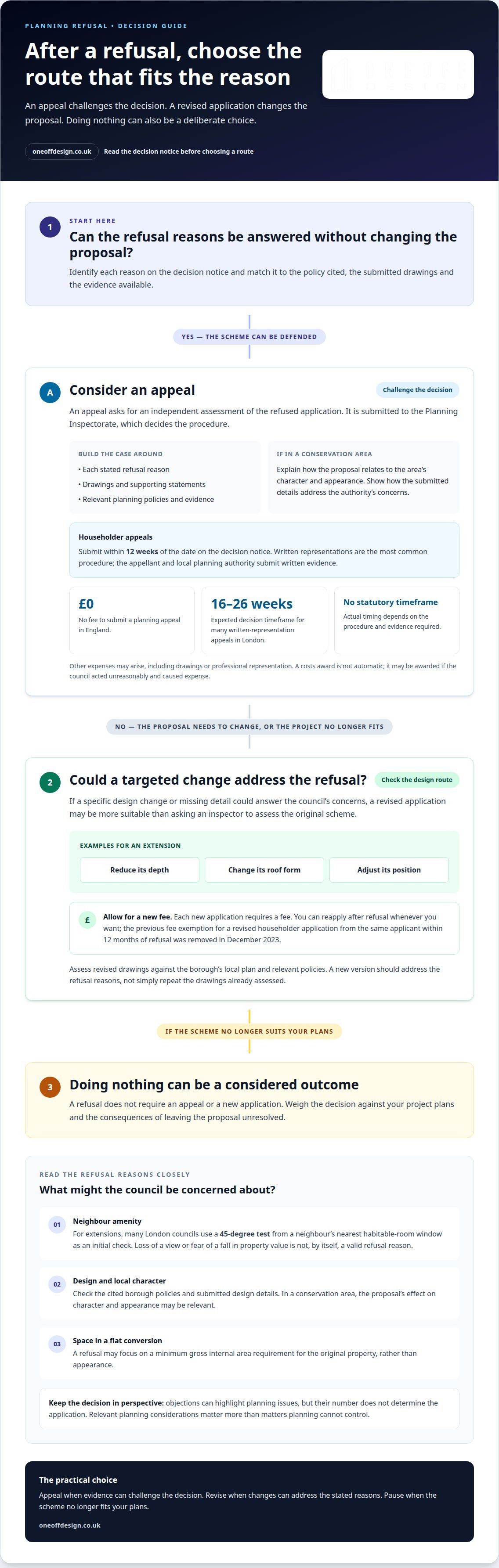
An appeal asks for an independent assessment of the refused application, rather than simply repeating it. In England, appeals are submitted to the Planning Inspectorate, which decides the appeal procedure.
Preparing an Appeal and Securing Representation
Preparing an appeal means explaining why the authority’s decision should be changed, with evidence that responds to its reasons for refusal. A clear case matters because the assessment centres on the proposal, relevant planning policies and the evidence submitted.
Start with the decision notice: identify each refusal reason, then match it to drawings, supporting statements or policy evidence. For a proposal in a conservation area, explain how its design relates to the area’s character and appearance. Avoid general claims that the design is attractive; show how the submitted details address the authority’s concerns.
Professional representation can help organise your case and present planning arguments clearly. To find London borough planning appeal decisions, search the relevant borough’s planning records and the Planning Inspectorate’s appeal decisions. For local planning policies, use the borough’s planning policy pages and identify the policies relevant to the refusal reasons.
Householder Appeal Procedures
A householder appeal is the route for challenging a decision on a householder planning application. In England, the deadline for submitting a householder planning appeal is 12 weeks from the date on the decision notice, according to the Ministry of Housing, Communities and Local Government.
Written representations are the most common procedure for householder appeals. The appellant and local planning authority submit written evidence, and the Planning Inspectorate selects the procedure for determining the appeal. State which procedure you consider appropriate and explain why.
An appeal should address the refused scheme and the council’s stated reasons. If revised drawings would materially change the proposal, consider whether an amended application would be more suitable than asking an inspector to assess the original scheme. In a conservation area, focus your evidence on the proposal’s effect on local character and appearance.
Appeal Fees and Determination Times
There is no fee to submit a planning appeal in England. However, other expenses may arise, such as preparing drawings or obtaining professional representation. An appeal also takes time, so weigh the project’s timing against the strength of your planning case.
Planning appeals have no statutory timeframe for determination. For many written-representation appeals in London, the stated expected decision timeframe is 16-26 weeks after submission. The actual process depends on the procedure selected and the evidence required.
Winning an appeal does not automatically mean costs will be awarded. Costs may be awarded if the council acted unreasonably and caused the applicant expense. Treat a costs award as a separate matter, not an assumed result of a successful appeal.
Common reasons planning applications are refused
A London planning decision should explain the authority’s reasons for refusing an application and identify relevant development-plan policies. Article 35 of the Town and Country Planning (Development Management Procedure) (England) Order 2015 sets out this requirement. Read each reason alongside the policy it cites. This separates design concerns from objections about matters the planning authority can’t control, and shows what evidence a revised proposal may need.
For extensions, neighbours’ amenity can be a central concern. Many London councils use a 45-degree test from a neighbour’s nearest habitable-room window as an initial check on an extension’s impact. It helps assess the relationship between the proposed structure and neighbouring windows. A neighbour losing a view or fearing a fall in property value, however, isn’t a valid reason by itself to refuse planning permission. The decision turns on planning considerations.
Design and local character can also affect the assessment. The National Planning Policy Framework and the borough’s local planning policies guide whether development is acceptable in principle. In a conservation area, the proposal’s effect on its character and appearance may be relevant. The decision notice should connect that concern to the scheme, rather than rely on a general objection to change. Compare the cited policies with the drawings and design details you submitted.
Flat-conversion proposals may face a minimum gross internal area requirement for the original property. A refusal may therefore focus on the available space rather than the conversion’s appearance. Objections can draw attention to planning issues, but their number doesn’t determine the application; relevant planning considerations carry more weight than matters planning cannot control. For an appeal, ask whether the decision gives a specific planning reason that evidence can answer. Assess each reason separately before deciding what to do next.
Amending and resubmitting an application
A refusal doesn’t prevent you from submitting a revised planning application. In England, you can reapply after refusal whenever you want, but each new application requires a fee. The previous fee exemption for a revised householder application from the same applicant within 12 months of refusal was removed in December 2023. A new version should address the refusal reasons, not simply repeat the drawings the council assessed.
Match each refusal reason to a design change or missing detail. For an extension, that could mean reducing its depth, changing its roof form or adjusting its position to address the specific concern. Then assess the revised drawings against the borough’s local plan and relevant policies. Discuss possible changes with the local planning authority; a targeted revision may resolve the issue more directly than an appeal.
Missing information can also affect an application’s assessment. If the decision identifies unclear drawings or inadequate supporting evidence, make those details precise in your next submission. For example, show dimensions and relationships with neighbouring properties clearly if the council raised concerns about an extension’s impact. Pre-application advice can help clarify how the authority views proposed changes.
Change of use proposals need a different policy check. The Town and Country Planning (Use Classes) Order dates from 1987 and has been amended; the relevant use class can shape how a proposed change is assessed. Permitted development rights generally apply to houses, not flats or maisonettes, and an Article 4 direction can remove those rights. A permitted development route also doesn’t remove the need for Listed Building Consent. If the refusal concerns use, establish the existing and proposed uses before preparing another application. The right revision depends on the refusal reasons, the local plan and the property’s status.
Doing nothing after a planning refusal
Taking no further action is a choice, not an appeal or a revised application. The decision notice still records the refusal, and the scheme cannot proceed on the strength of that refused application. If your plans have changed, pausing may save time that would otherwise go into redesigning a proposal you no longer want. Distinguish putting the project aside from treating permission as granted.
A refusal remains on the borough’s public planning register. Earlier decisions on a property are a material consideration in later applications, so the refusal may inform how a future proposal is assessed. That doesn’t prevent a different scheme, but repeating the same design without addressing the recorded reasons leaves the central planning issues unresolved.
What happens if you start building after planning permission is refused? Building the refused scheme before an appeal is allowed can lead to enforcement action. A pending appeal is not permission to build. Keep the decision notice and submitted drawings together, and don’t treat the Planning Inspectorate process as approval while a decision is outstanding.
Doing nothing can also give you time to reconsider the project’s purpose. For example, if an extension was intended to meet a household need that has changed, leaving the application alone may be more sensible than pursuing a scheme that no longer fits. If the property has heritage significance or is in a conservation area, a later design may need to respond differently to its local setting.
Make the pause deliberate: retain the refusal reasons, note which design or planning issues would need attention, and revisit them only if your priorities change. If you decide a new proposal is worthwhile, develop a revised planning proposal around the borough’s recorded concerns. Doing nothing keeps the current refusal in place; it doesn’t resolve it, but it also doesn’t require you to pursue a project you no longer intend to build.
Oneoff Design: Planning
Oneoff Design helps shape planning applications and design changes around the council’s refusal reasons. If you’re weighing an appeal against a revised proposal, its planning work can help clarify how the scheme and supporting drawings address the issues raised.
For a refused extension or new build, the next step may be a more considered design supported by clear CAD drawings. The aim is to make the proposal and its planning case work together, whether you’re preparing a new application or refining an existing scheme. If you’re not ready to proceed, you can pause and return when your plans are clearer.
Contact Oneoff Design to discuss the refusal and the route you’re considering.
Choose a clear direction for your project
If your planning permission has been refused in London, deciding what comes next starts with the result you want for the property. Before committing to another design, consider which qualities matter most: more usable space, greater privacy, better light or flexibility for future needs. Those priorities can guide a fresh approach instead of letting the refused scheme dictate every decision.
Set a clear purpose for the next stage. You might refine the proposal, pursue a different design direction or put the project aside while your plans develop. Make the choice deliberately, with the refusal reasons and your practical priorities in view.
A considered design process can turn a planning setback into a sharper brief. Bring together the decision notice, your aims for the property and the changes you’re considering. Discuss your options with Oneoff Design and decide on a considered next step. Your project can move forward with greater clarity and purpose.
Frequently Asked Questions
So, your planning permission was refused. What next?
First, decide whether you still want the development in its current form. If you do, separate the council’s concerns from your own priorities, such as extra living space or access to a garden. Then choose whether to challenge the decision, redesign the proposal or pause the project. Don’t start building the refused scheme; the council may take enforcement action.
Does a planning refusal affect the value of my property?
A refusal is not a property valuation and does not itself set an asking price or establish a loss in value. It does remain on the council’s public planning register, and an earlier decision can be a material consideration in a later application. Keep the notice with the property records so its planning history can be understood alongside any future proposal.
Should you appeal or resubmit?
Appeal if you believe the council’s assessment of the submitted scheme was wrong and can support that position with relevant evidence. Submit a new application if you’re prepared to change the design or provide information addressing the refusal. For example, an appeal may focus on how the decision applied policy, while a new application could present a revised layout.
Which refusal reasons can be fixed, and how?
Reasons tied to the proposal’s design or supporting material can often be addressed through clearer drawings, additional evidence or design changes. For example, a revised extension might alter its scale or position to respond to a specific concern about its effect on neighbours. A conflict with local policy may call for a more substantial redesign. Match each proposed change to the exact concern it is meant to resolve.
Why might a London planning application be refused?
A London borough may refuse a proposal because of its effect on neighbours, its design, its relationship with local policies or its impact on a conservation area. Flat conversions may also raise questions about the original property’s internal floor area. The decision should identify planning reasons, rather than rely solely on objections about a lost view or a possible effect on property value.
How do I read the council’s planning refusal notice and identify the reasons?
Read the formal refusal wording in the decision notice, not just the accompanying officer comments. Mark each numbered reason and note any development-plan policy cited. Then compare those points with the submitted drawings and supporting documents. This helps distinguish a design objection from a missing-information issue and gives you a clearer basis for deciding what to change or challenge.


