

A build can be close to completion and still be delayed by a missed notice, unresolved claim or unclear decision. Construction contract administration in Cambridge keeps the contract procedures on track by managing information, notices, payment assessments and claims, and maintaining records that support decisions. The administrator’s responsibilities depend on the contract and project type.
It is easy to think of the role as paperwork. In practice, it connects day-to-day project decisions with progress, completion and handover. This article explains what contract administration covers, how an administrator may assess extensions of time and manage certificates, and why responsibilities vary between project arrangements. Organised oversight from the outset helps project parties meet contractual obligations and address issues before they disrupt delivery.
Key Takeaways
- Map the contract’s notice, information and decision-making steps early so responsibilities are clear from the outset.
- For extra payment or time claims, organise the supporting records and follow the contract’s procedures promptly.
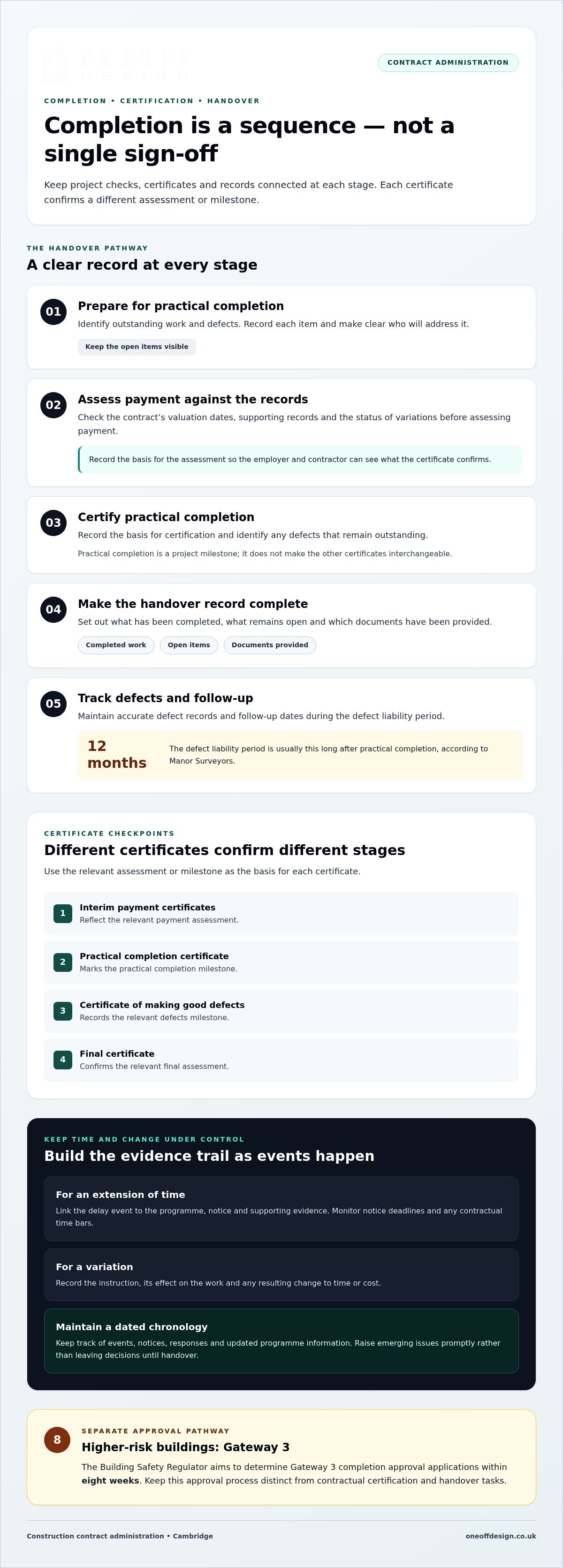
- Plan completion and handover as a sequence of checks and certificates, not a single final event.
- Match administration duties to the project arrangement; for higher-risk buildings in England, the Building Safety Act 2022 is relevant to the role, according to UK legislation register.
What is contract administration?
Construction contract administration manages the notices, records, valuations and decisions required under a building contract. On Cambridge projects, it connects events on site to contractual action, including claims for additional payment or time.
Extra payment and loss claims
An extra-payment claim seeks payment for work or costs beyond the agreed contract sum. A loss and expense claim concerns losses arising from events covered by the contract. The administrator reviews the contractual basis, notices, records and cost evidence before assessing a claim.
Keep dated records of instructions, delays, labour, materials and correspondence. For example, pair a variation instruction with supporting cost details to give the employer a clear record for reviewing the amount claimed. Link the event, evidence and claimed impact.
Dispute resolution and claims management
Claims management starts by identifying the event, the contract terms relied on and any notice requirements. The administrator considers the supporting information, communicates the assessment and records the decision, helping the parties understand where they agree and where they differ.
Decisions may be challenged through dispute-resolution procedures unless the contract makes them final and conclusive. Clear, contemporaneous records show what happened, when notices were given and how a claimed sum or delay was calculated. This gives each party a factual basis for addressing disagreements.
JCT contract responsibilities and risks
Under a JCT building contract, what are the contract administrator’s responsibilities? The administrator manages the contract’s procedures, including information, notices, change control, payment assessments and relevant instructions. The signed contract sets out the specific duties and decision-making process.
What are the risks of poor administration on Cambridge projects, and how can disputes be avoided? Late notices or incomplete records can delay delivery, increase costs and prompt claims. Log instructions and deadlines, raise progress concerns promptly, and retain evidence for each assessment.
For a delay claim, organise the chronology around the event, notice, effect on the programme and remedy sought. Claims can be technically challenging and involve significant sums, so precise records help clarify the basis of each party’s position.
Completion, handover and extensions of time
Completion administration connects site progress with contractual milestones and handover records. Follow the contract’s notice and certification procedures at each step.
Completion and handover
Before practical completion, identify outstanding work, record defects and set out who will address each item. The handover record should make clear what has been completed, what remains open and which documents have been provided. According to Manor Surveyors, the defect liability period is usually 12 months after practical completion. This period makes accurate defect records and follow-up dates important.
For higher-risk buildings, the Building Safety Regulator aims to determine Gateway 3 completion approval applications within eight weeks. Keep this approval process distinct from contractual certification and handover tasks.
Payment and completion certificates
Certificates mark different stages and are not interchangeable paperwork. An administrator may issue interim payment certificates, a practical completion certificate, a certificate of making good defects and a final certificate. Each should reflect the relevant assessment or project milestone.
Before assessing payment, check the contract’s valuation dates, supporting records and status of variations. At completion, record the basis for certification and any outstanding defects. Clear documentation helps the employer and contractor track what each certificate confirms.
Notice compliance and time bars
For an extension of time, link the delay event to the programme, notice and supporting evidence. Monitor notice deadlines and any time bars in the contract, as late compliance can affect claims and disrupt progress. Keep a dated chronology of events, notices, responses and updated programme information.
Apply the same discipline to variations. Record the instruction, its effect on the work and any resulting change to time or cost. Raise emerging issues with project parties promptly, so decisions and required notices are not left until handover.
The Construction Act and Building Regulations form part of the UK framework relevant to construction projects; the contract administrator must also follow the project’s contractual procedures. For higher-risk buildings in England, the Building Safety Act 2022 is relevant to the role, according to UK legislation register. Clear building control planning can help organise approval steps alongside project records.
Contract administrator roles on different project types
The administrator’s duties depend on the contract, procurement route and construction project. Across projects, the role may include progress reporting, coordinating inspections and resolving issues. For construction contract administration in Cambridge, responsibilities should match the project’s delivery structure and contractual arrangements.
When assessing an administrator for a Cambridge project, consider their experience with your contract form and project type. Look for a clear approach to record keeping, risk reviews, reporting and communication between the employer and project team. The right approach to construction contract administration in Cambridge depends on the project’s scope and procurement route.
How much do construction contract administration services cost in Cambridge? The price depends on the case and is given after a quote request. Scope, project duration, procurement route and the level of site coordination affect the work involved.
Agree the scope and responsibilities at the outset, including how instructions, assessments and changes will be recorded. Clear arrangements help the parties understand the administrator’s role throughout the project.
JCT and NEC are construction contract forms, while RIBA publishes professional appointment documents. Compare the contract and appointment documents to establish who administers each obligation and makes project decisions.
Cambridge projects follow the national framework, with site-specific planning and building control matters shaping project conditions. Identify relevant approvals at the outset and reflect them in the programme and allocation of responsibilities.
On traditionally procured infrastructure projects, the administrator coordinates the employer’s requirements, design information, tender documents and construction-stage processes. Clear responsibility for instructions helps align separate design and delivery teams.
Marine construction involves scheduling interfaces between specialist work, equipment and site operations. Map programme dependencies, record constraints and review changes with relevant project-team members.
Assess each project risk by recording its owner, response and review point. For example, log a delayed design decision, assign an action and track it against upcoming work. Progress meetings help the team identify issues and agree resolutions.
Construction contract administration
Effective administration turns contract obligations into a working process, keeping decisions, records and responsibilities connected. Start by assigning each action to a named project role and tracking its status.
Variation administration
How should variations, extensions of time, payment applications and defects be administered? Record each variation’s instruction, scope, effect on the programme and cost assessment. Assess extension claims against the contract procedure and evidence, then communicate the decision to the relevant parties.
Keep a change log linking each instruction to revised drawings, approvals and work on site. This gives the employer a clear view of what changed, who authorised it and which contractual steps remain. The administrator should seek client instructions where required by the contract, rather than allowing informal site discussions to redefine obligations.
For higher-risk buildings in England, the Building Safety Act 2022 is relevant to the contract administrator’s role, according to UK legislation register. Record how applicable project decisions and information are handled alongside contract changes.
Payment applications and defects
For each payment application, compare the claimed work with the contract’s valuation basis and supporting project records. Identify the assessed amount, explain any adjustment and keep the reasoning with the payment documentation. Consistent records make the assessment traceable for the employer and contractor.
Log defects by location, description, responsible party and agreed action. Update each item’s status during inspections and retain evidence of remedial work. Link unresolved defects to the relevant completion records, so the project team can distinguish completed work from outstanding actions.
Decision-making also requires sound knowledge of the contract and a fair, reasonable approach. Regular reports should track time, cost, quality and risk, while keeping project parties informed about outstanding actions and decisions.
Bring structure to your project’s planning and approval steps by setting out your next project actions.
Manor Surveyors says contract administrators should act independently, impartially and fairly when making decisions. They should also act honestly and reasonably when certifying, assessing or deciding. The client or employer generally appoints the administrator early, since a late appointment can mean contractual obligations have already been missed.
Oneoff Design: Extensions
Oneoff Design develops bespoke designs for extensions and new builds, helping you shape the project before construction begins. If you’re planning an extension, clear drawings and visualisations can help communicate the proposed design and inform early project discussions.
Its work includes CAD and 3D Visualisation, supporting a more considered view of the design. These services sit alongside contract administration, rather than replacing the administrator’s role in managing contractual procedures during construction. That distinction helps you identify the right support at each stage: design development first, then contract administration for project obligations and delivery processes.
If you’re ready to develop an extension or new-build proposal, visit Oneoff Design to discuss your project.
Give your project a clear starting point
Before committing to the next stage, define what the project needs to achieve. Gather existing drawings, outline your priorities and note any constraints that may shape the design. A clear brief gives the project team a sound basis for decisions and helps identify which matters need resolving first.
For construction contract administration in Cambridge, clarity from the outset matters. Define who will make project decisions, how information will be shared and what the administrator is expected to manage. These foundations connect the project’s aims with its working arrangements, instead of leaving responsibilities to emerge as issues arise.
Use this early stage to consider how your design and delivery plans fit together. A focused conversation about your project can help you determine the next design steps and the information needed to progress. Contact Oneoff Design about your project and take the next step with a clear direction.
Frequently Asked Questions
What does construction contract administration involve in the UK?
In the UK, construction contract administration organises how the employer and contractor carry out their agreement, from tender documentation through delivery and close-out. The administrator’s authority comes from the contract and appointment, so establish who can issue instructions, assess applications and make decisions before work starts. The role is contractual and administrative; it does not involve carrying out construction work.
What are the steps in construction contract administration from tender and contract signing to completion?
Start by defining the scope and preparing tender documents. Invite bids, record clarifications and agree the selected tender’s contract particulars before signing. Before mobilisation, set up registers for submissions, instructions, decisions and deadlines. During the works, administer changes and applications against the agreed terms. At completion, identify outstanding items, reconcile project records and complete contractual close-out with the employer.
Which construction contract forms are commonly used in Cambridge, such as JCT, NEC and RIBA?
JCT and NEC are construction contract forms, while RIBA publishes professional appointment documents. Compare the contract and appointment documents to establish who administers each obligation and makes project decisions.


