

Cambridge construction tenders cover new-build and civil-engineering works, retrofit frameworks, building upgrades and pre-construction support. A tender package for construction in Cambridge sets out the work through drawings, specifications, pricing documents and contract terms. Clear package boundaries and interfaces help bidders understand exactly what they are pricing.
Finding an opportunity is only the first step. The documents must align, costs must be based on a clear scope, subcontractor quotations must be coordinated, and the submission must follow the tender instructions.
This guide explains which opportunities to look for and how to prepare a complete, well-structured bid. It covers what to include in the package, how to manage pricing and quotations, and how to handle clarifications and submission requirements.
Key Takeaways
- Build the tender package around clear drawings, specifications, pricing documents and contract terms, with scope and interfaces defined for each work package.
- Prepare a bid by matching every price and subcontractor quote to the stated scope, then organise the return documents to meet the tender instructions.
- Use written clarification questions to resolve gaps in the scope or drawings; answers are shared with all bidders so they receive the same information.
- For smaller public contracts with central government, the Cabinet Office says contracts above £12,000 including VAT are usually listed on Contracts Finder.
- Public tender criteria are set out in the tender documents, so shape your submission around the stated balance of price and quality.
Tender documents: drawings, specifications, pricing documents and contract terms
A complete tender package gives contractors and suppliers a defined scope, a pricing basis and clear instructions for returning their bids. For a tender package for construction in Cambridge, first check that every drawing, specification and contract document describes the same work.
Include building regulations drawings, product specifications and details of the finished project’s appearance and quality. A main contract package typically contains an invitation to tender, form of tender, preliminaries, contract documents, pricing documents, design information, specifications and a tender return slip. Bills of quantities can help bidders price measured work against the stated scope.
Divide complex work into packages, each with its own drawings and specifications. Then identify the interfaces between them. For example, sliding automatic doors may be in a separate package, while associated builders’ work sits in the electrical package. Clear boundaries reduce the risk of omitted or duplicated work.
Pricing documents and contract sum analysis
Check the pricing document’s structure before entering rates. Match each item to the relevant drawing and specification, then record assumptions, exclusions and provisional items separately. A contract sum analysis should make the build-up legible, so the tenderer and client can trace how the offered sum relates to the work. Compare subcontractor quotations against the same scope before incorporating them.
There is no single typical preparation cost or Cambridge project value. Preparation effort depends on drawing completeness, package count, quantity measurement, surveys and programme detail. Project value depends on scope, specification, site constraints and risk allocation.
Contract terms and bidder risks
Read preliminaries and contract terms alongside the drawings, not after pricing. Check payment provisions, programme obligations, design responsibility, change procedures, delay consequences and stated exclusions. Compare every allowance with the tender scope. An overlooked interface, such as builders’ work around a specialist installation, can leave a pricing gap or disputed responsibility after award.
Tenderers must meet the insurance limits, financial-standing tests and health-and-safety requirements specified in the tender documents. Because requirements are set for each contract, bidders should follow the stated criteria rather than assume one standard applies across Cambridge.
Public clients assess bids against criteria published in the tender documents, usually combining price and quality. Follow the stated weightings and response format. Address each quality criterion with relevant evidence, and make sure the price submission matches the scope.
For leads sent directly by main contractors, record the issuing organisation, package scope, return date and document revision. Treat restricted-circulation opportunities as confidential, and price only the documents issued for that bid. Keep a record of each submitted version.
A contract award notice for the Framework for Applied Science Technology and Engineering Requirements began an eight-day standstill period, ending on 17 April 2026. After award, use the contract’s mobilisation requirements to organise responsibilities, programme information and handover records before work begins.
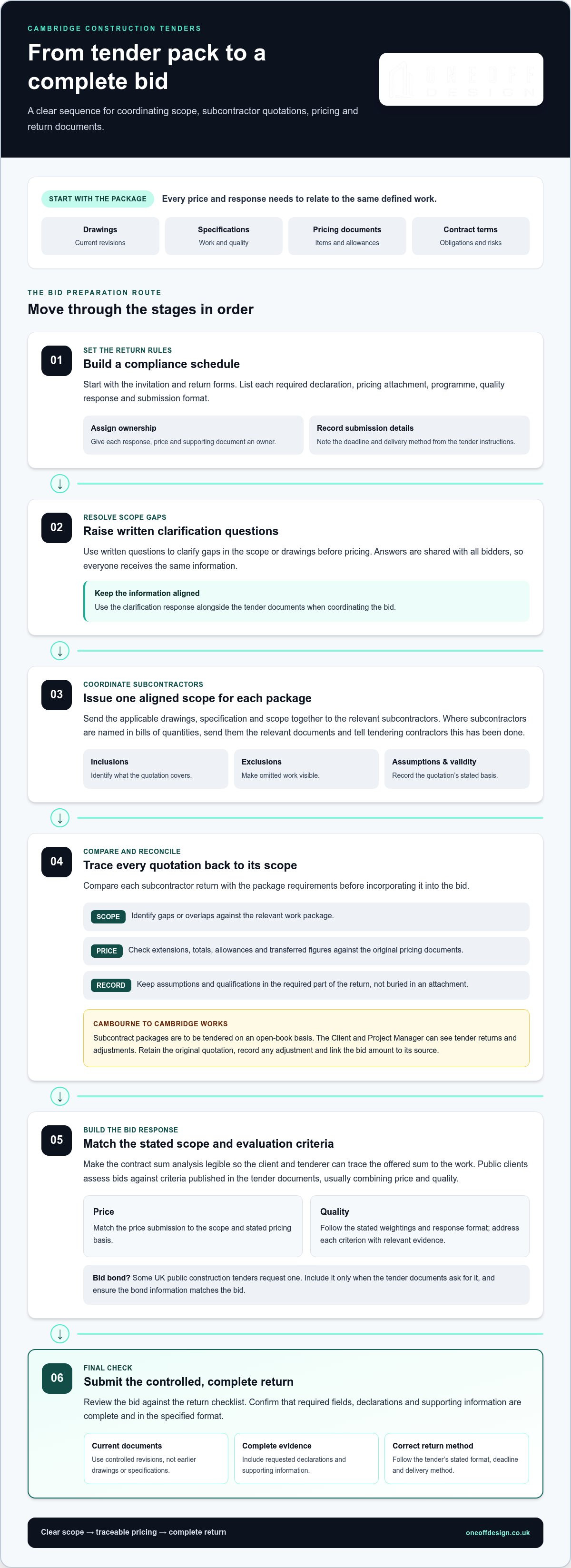
Bid preparation, subcontractor quotes and submission
A strong bid follows the tender instructions in order. Start with the return checklist, then assign an owner to each response, price and supporting document. For public sector work, answer the published requirements clearly. Do not rely on material the evaluator has not requested.
Build a compliance schedule from the invitation and return forms. Record every required declaration, pricing attachment, programme, quality response and submission format. Note the deadline and delivery method. Keep a controlled document register so the final bid uses current revisions, not an earlier drawing or specification.
Subcontractor pricing needs the same discipline. Send relevant documents directly to subcontractors named in bills of quantities, and tell tendering contractors this has been done. Issue the applicable drawings, specification and scope together. Ask for quotations that identify inclusions, exclusions, assumptions and validity, then compare each return with the package requirements.
For the Cambourne to Cambridge works, subcontract packages are to be tendered on an open-book basis. The Client and Project Manager can see tender returns and adjustments. Traceable quote comparisons are therefore essential: retain the original quotation, record any adjustment, and link the amount included in the bid to its source.
- Reconcile scope: match each subcontractor quotation to the relevant work package and identify gaps or overlaps.
- Check arithmetic: review extensions, totals, allowances and transferred figures against the original pricing documents.
- Control assumptions: state qualifications in the required part of the return, rather than burying them in an attachment.
- Complete evidence: include requested declarations and supporting information in the specified format.
Some UK public construction tenders ask for a bid bond, which guarantees that the bidder will honour its price if selected. Treat this as a specific tender requirement, not a standard assumption. Include it only when the documents request it, and ensure the bond information matches the bid.
Before submission, review the bid against the return checklist. Confirm that every required field is complete, figures agree across forms, attachments open correctly and the authorised signatory has approved the return. Keep a copy of the submitted package and record its version, delivery method and timestamp.
The Cambridge retrofit framework illustrates why deadlines must be treated as fixed controls: its submission deadline was 28 September 2022. That opportunity is historical, but the practical lesson remains. Work backwards from each tender’s stated deadline, allowing time for internal review and corrections. A late or incomplete return can fail before its technical merits are assessed.
Clarifications and bidder communications
A drawing conflict can affect a construction price. Bidders can use written queries to clarify unclear scope or drawings, and written responses can help ensure that bidders receive the same information. Use this process to resolve uncertainty before finalising your submission.
Start with a precise document reference. Identify the drawing number, specification clause or pricing item, then describe the conflict and its effect. For example, if a door schedule and a plan show different opening widths, ask which dimension governs. Avoid broad questions such as “Please clarify the doors”. They make it harder to provide a useful answer.
Use the tender’s stated communication method and query format. Keep each question focused on one issue, and submit it within the clarification period set out in the documents. A government tender may specify a portal or named communication channel. Sending questions through several routes can fragment the record and make responses harder to track.
The written answer matters to every bidder. If the client confirms a revised dimension, specification or package boundary, apply it consistently across the price, programme and subcontractor enquiries. Do not rely on an informal conversation or assume a verbal comment changes the tender documents.
- Log the query: record its reference, document revision, date submitted and affected work package.
- Track the response: note the client’s written answer and any revised drawing or specification.
- Assess the impact: identify changes to quantities, labour, materials, sequencing or subcontractor scope.
- Update the bid: carry the agreed interpretation into the pricing documents and quality response.
For a subcontract package, send the relevant clarification to the affected supplier after the client issues its response. Request a revised quotation if the answer changes the scope or quantities. Retain the original and revised returns so the adjustment can be traced to the client’s written instruction.
Keep a controlled clarification register alongside the tender documents. Give every entry a clear status, such as submitted, answered or incorporated. Before submission, compare the register with the latest pricing and technical responses. This final reconciliation can reveal an unanswered query or a change that has not reached the cost build-up.
If an answer appears to change the original scope, read it alongside any formal amendment or revised document issued by the client. Update the affected bid sections rather than adding a conflicting qualification. If the response leaves a genuine interpretation issue, frame a concise follow-up question using the original reference and the tender’s prescribed method.
A disciplined record keeps the main bid, supplier quotations and final submission consistent. The same written clarification informs each, giving the evaluation team a clear account of how the tenderer interpreted the documents and priced the stated work.
Finding UK construction tender opportunities
Cambridge construction opportunities appear through national public procurement notices, council frameworks and early pipeline announcements. Cambridge City Council and Cambridgeshire County Council use public notices and framework arrangements; the available examples include Cambridge City Council’s Action on Energy Cambridgeshire Retrofit Framework. Search by contracting authority, project type and notice stage, rather than relying on one tender title.
In the UK, smaller public contracts above £12,000 including VAT with central government are usually listed on Contracts Finder, according to the Cabinet Office. Find a Tender carries public contracts above the stated thresholds. It replaced the EU’s Tenders Electronic Daily on 1 January 2021. Check both services using construction-related terms, authority names and relevant work categories.
Cambridge City Council’s retrofit framework shows why notice type matters. Its tender notice was published on 17 August 2022, and its award notice followed on 8 August 2023. The framework was intended to run for four years and award agreements to no more than six contractors. It is a past procurement, but illustrates how frameworks can offer work through later opportunities governed by their agreement.
For each result, identify whether it is a pipeline notice, preliminary market engagement, tender notice, award or termination. The Cambourne to Cambridge procurement had a pipeline notice dated 23 April 2025 and preliminary market engagement notice dated 29 January 2026. A termination notice followed on 4 March 2026. Read the latest notice before treating an opportunity as open.
The Cambridge South West Travel Hub listing gives another useful distinction. It describes a proposed park and ride at the A10/M11 junction and carries reference ID 139294173, notice identifier 2026/S 000-032433 and CPV code 45200000. The listing appears to provide procurement information rather than a direct invitation to bid. Treat it as procurement information, not an invitation to submit a bid.
- Search consistently: combine “construction” with council names, place names and relevant work descriptions.
- Classify the notice: distinguish a forecast or engagement notice from an active tender.
- Capture identifiers: record the notice reference, authority, scope and publication date.
- Review frameworks: note their term, contractor limits and how later opportunities are offered.
Frameworks have their own access rules. Under Cambridge City Council’s retrofit framework, each opportunity under the Framework part was to be offered to all contractors as set out in the Framework Agreement. Read the agreement’s process and scope before deciding whether a notice applies to your business.
Create an opportunity register with the client, notice status, relevant packages, documents and next action. Revisit pipeline information as procurement develops, then reassess the official notice before committing bid resources. This separates early intelligence from a live invitation and keeps Cambridge tender searches focused.
What procurement rules apply to public construction tenders in Cambridge and the UK?
Public construction procurement follows the rules in force when the authority begins its process. The Procurement Act 2023 came into force in the United Kingdom on 24 February 2025. For each Cambridge opportunity, identify the notice date, procedure and tender instructions before preparing a bid.
Thresholds help determine which public procurement regime applies. For the period from 1 January 2026 to 31 December 2027, the stated threshold for UK works contracts is £5,193,000 including VAT. The stated thresholds are £135,018 for goods or services contracts with a central government body, and £207,720 for goods or services contracts with a sub-central body such as a local council. These figures distinguish contract types; they are not construction project budgets.
Cambridge procurement history can involve earlier rules. Cambridge City Council’s Action on Energy Cambridgeshire Retrofit Framework was conducted under the Public Contracts Regulations 2015 and used the Open Procedure. Treat that as context for that procurement, not as a rule for every current tender. The notice and tender documents identify the procedure governing the specific opportunity.
Under the current framework, the procurement strategy may include dialogue and negotiation during tendering. Read the process instructions carefully: they explain whether dialogue is available, how it works and when bidders may respond. Authorities also assess bids against criteria published in the tender documents, usually combining price and quality. Structure answers around those criteria rather than assuming price alone decides.
Public sector contracting authorities are expected to apply the National Procurement Policy Statement published in February 2025 when preparing tender documentation. For a bidder, the practical test remains the published specification, selection requirements and award criteria. Keep evidence specific to each requirement, and make sure the pricing schedule aligns with the proposed delivery method.
Use this sequence for a Cambridge public tender:
- Identify the authority and contract type: distinguish works from goods or services.
- Read the notice and procedure: establish the relevant process and timetable.
- Map the evaluation criteria: connect each response to the published quality or price requirement.
- Check amendments: ensure your submission reflects the latest tender documents and instructions.
These rules shape how a public client invites, assesses and awards work. They do not replace the project-specific scope or contract conditions. Keep a clear record of the applicable notice and documents as you develop the bid. Organise your project documentation around the stated design and compliance information.
Oneoff Design: Extensions
Oneoff Design can help when your next step is developing an extension or new-build design. Clear drawings and visual material provide a more coordinated basis for discussing the project and its requirements.
CAD drafting supports precise technical information, whilst 3D Visualisation helps you understand the proposed form and appearance. These design services are relevant before tender documents are assembled, when key decisions about layout and design need to be communicated clearly. They support your project design, not the physical construction work.
If you’re planning an extension or new build, contact Oneoff Design to discuss your project, or visit oneoffdesign.co.uk.
Set your next project up with clear design information
A well-prepared tender depends on a scope that can be understood and priced. If your next step is developing an extension or new-build project, precise design information can help establish a clear foundation before tender documents are prepared.
Oneoff Design provides Extensions, New Builds and CAD. Its design development and technical drawings give you a defined starting point for project decisions. A tender package for construction in Cambridge is part of a wider process, and its usefulness depends on the clarity of the information behind it.
Bring your project requirements together, identify the decisions that need design input, and take the next step with a clear brief. Contact Oneoff Design to discuss your project. A considered start can help you move forward with greater clarity.
Frequently Asked Questions
What types of construction tenders can I find?
Cambridge construction opportunities can cover new-build projects, civil engineering, retrofit work, building upgrades and pre-construction services. A tender may seek a main contractor for a complete project or suppliers for a defined trade package. Frameworks offer another route, with later work allocated under the framework agreement’s process. Match the opportunity to your experience and capacity, then read the notice to see whether it invites bids or signals future procurement.
What are tender documents?
Tender documents are the client’s formal information for inviting and assessing bids. They explain the required work, contract conditions, response format and evaluation method. For example, a contractor uses them to identify the scope and prepare a price, while a supplier uses relevant package documents to quote for its portion. Revisions and written clarifications form part of the working record for an accurate response.
What opportunities will you find?
You may find tenders for construction delivery, retrofit, specialist installations, surveys, design support or project programming. Cambridge examples include the Action on Energy Cambridgeshire Retrofit Framework and the Cambourne to Cambridge scheme. These examples illustrate different procurement types, not necessarily open opportunities. Check each notice’s status and dates before planning a bid. A pipeline notice can indicate future procurement, while a tender notice sets out an invitation and submission requirements.
What documents are included in a construction tender package in Cambridge, UK?
A package commonly includes the invitation to tender, form of tender, preliminaries, contract documents, pricing documents, design information, specifications and return instructions. Drawings and bills of quantities provide further detail about the work and how it is measured. Check that drawing revisions match the specification and pricing schedule. For a trade package, identify its boundaries and interfaces with other work so your quotation does not omit an item another package assumes you will provide.
Where can I find current construction tender opportunities in Cambridge and Cambridgeshire?
Search Find a Tender for public contracts above the relevant thresholds and Contracts Finder for smaller central government opportunities. The Cabinet Office says smaller public contracts above £12,000 including VAT with central government are usually listed on Contracts Finder. Also search notices by Cambridge City Council and Cambridgeshire County Council, and review framework announcements. Check publication dates, notice status and procurement identifiers to distinguish a live invitation from an award, pipeline or historical listing.
What are the typical requirements for submitting a construction tender in Cambridge?
Requirements depend on the tender documents, which specify declarations, insurance evidence, financial-standing information and health-and-safety material. The client also sets the pricing and quality responses, supporting documents, submission format and evaluation criteria. Build a compliance checklist from those instructions. For example, if the tender requests a programme and a quality response, ensure both address the stated scope and use consistent assumptions. Include a bid bond only if the documents require one.
What are the steps and deadlines for responding to a construction tender in Cambridge?
Start by recording the deadline and submission method in the notice. Review the documents, allocate response sections, request subcontractor quotations and submit clarification questions through the prescribed channel. Then reconcile the final price, supporting evidence and declarations against the return checklist. Allow time for internal review before the deadline, and retain the submitted version and delivery record. Dates vary by opportunity, so the tender notice and any formal updates govern your response timetable.


