

A successful ARB check is a starting point, not a recommendation. For homeowners, it can be hard to tell whether someone using the title architect is registered, or whether a search result leads to the official record. An ARB register check for architects gives you a reliable way to verify registration before discussing your project.
The title “architect” is protected in the UK, so checking the Architects Register matters. Registration alone doesn’t tell you whether someone is right for your home, your brief or the decisions ahead. This guide explains how to search the official ARB Register, what a result confirms and what it can’t establish.
Once you’ve verified registration, assess project fit: relevant experience, clear communication and an approach that suits you. Whether you’re considering an extension or a new build in London, Cambridge or elsewhere in the UK, start by checking registration, then consider the design, planning and project-management support your project needs.
Key Takeaways
- Use the official ARB Architects Register to verify whether a person is registered before progressing your project discussions.
- An ARB register check for architects confirms registration status, but doesn’t establish design specialism, relevant experience or project outcomes.
- Match experience to your brief, whether you’re planning an extension, a new build or another residential project.
- Prepare a clear brief covering your property, ambitions, constraints and the level of support you want.
- After verification, consider how design, planning and project management can support your home project.
What an ARB Register Check for Architects Can Tell You
Before discussing plans, fees or timescales for a home project, establish whether the person introducing themselves as an architect is registered. The official source is the Architects Registration Board (ARB) Architects Register, a public record of individuals entitled to use the protected title in the UK.
An ARB register check for architects confirms whether an individual appears on that record. It gives you an answer about registration status, but not whether they have the right experience for your property, understand your brief or are a good fit for how you want to work.
What the Architects Registration Board does
The ARB is the UK’s independent regulator of the architects’ profession. It maintains the Register, sets standards for architects’ conduct and practice, and protects the title “architect”. Its public Register lets homeowners check an individual’s status rather than relying on a search result, a job title on a website or a description of design services.
In the UK, it is illegal to use the title “architect” unless registered with the ARB. This legal protection applies to the title, not to every phrase associated with design. Someone may describe their services as architectural design, for example, but that wording alone doesn’t establish that they are a registered architect. The ARB Register is the relevant record for checking that status. For wider background on the regulator’s history and role, see the Architects Registration Board (ARB) Wikipedia page.
Why homeowners check before a design project
A registration check is a sensible first step before progressing a conversation about an extension, a new build or other residential work. It helps establish whether a person using the protected title is registered, so you can make an informed decision about what to discuss next. It doesn’t assess their design approach or select a suitable professional for you.
Homeowners in London and Cambridge use the same national Register. The check isn’t tied to a local authority or a particular project location. That’s useful if you’re considering design support across the UK or comparing people whose practices are based in different places.
An ARB Register check is a search of the official public record to verify whether an individual is registered to use the title “architect” in the UK. Treat it as a first checkpoint, not a complete assessment. Once you’ve established registration status, consider whether the person’s experience aligns with your project and whether their proposed design support suits the decisions you need to make.
How to Complete an ARB Register Check Step by Step
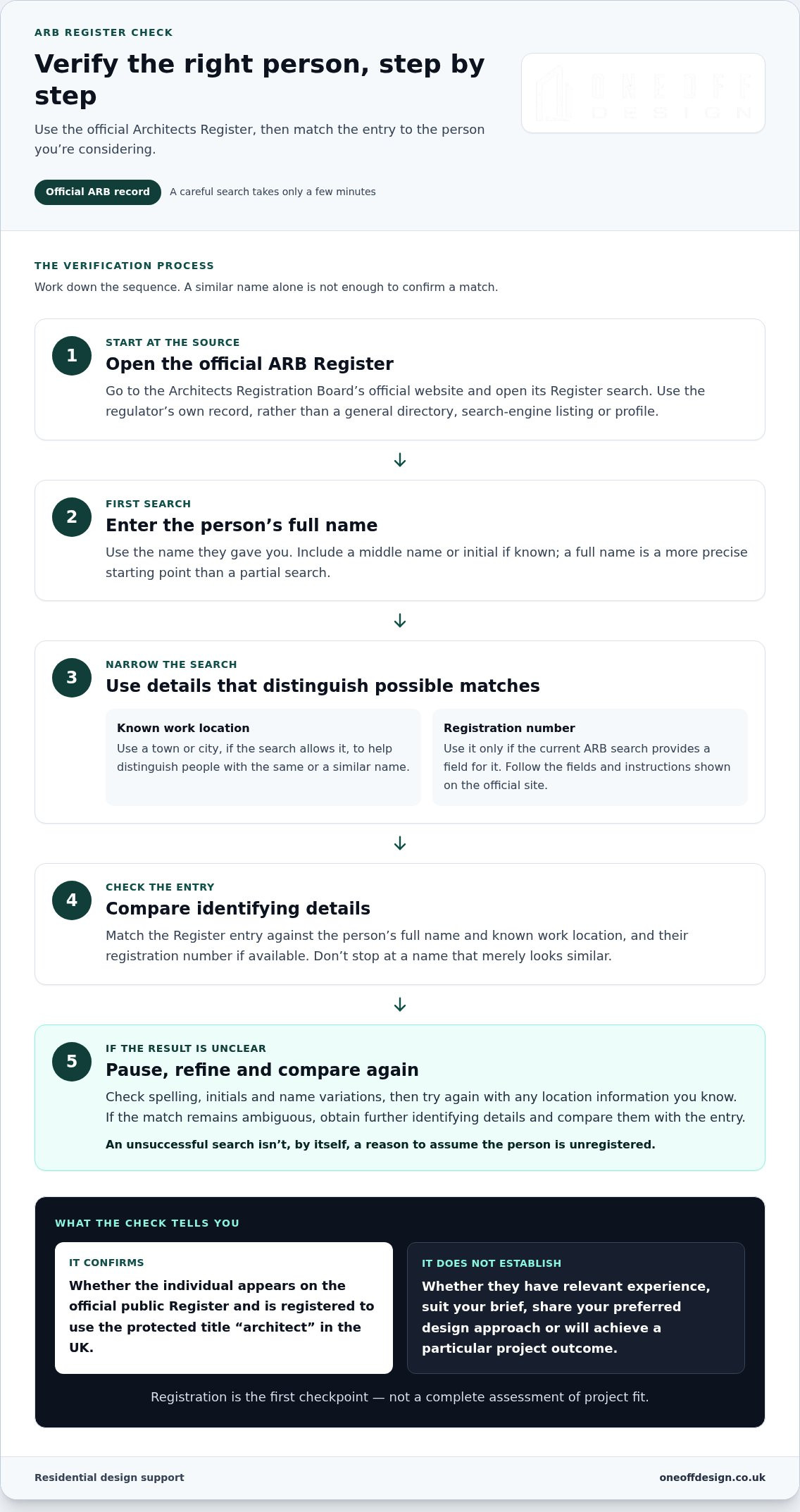
A careful search takes only a few minutes, but it’s important to match the result to the right person. Use the ARB’s official Architects Register, rather than relying on a general directory, a search-engine listing or a profile that may not show current registration status. Follow these steps to check the right person and avoid treating an unclear result as definite.
- Open the ARB Register. Go to the ARB’s official website and open its Register search. This ties your check to the regulator’s own record.
- Search the person’s full name. Enter the name the architect has given you, including a middle name or initial if known. A full name is a more precise starting point than a partial search.
- Narrow the results. If more than one person has the same or a similar name, use a known location, such as the town or city where the person works, if the search allows it. This may help distinguish between possible matches.
- Use a registration number if available. If the architect has given you a registration number, use it when the current ARB search provides a field for it. Follow the fields and instructions shown on the official site.
- Inspect the matching entry. Compare the result’s identifying details with the person you’re considering. Don’t stop at a name that looks similar.
Search by name, location or registration number
A name is usually the most practical first route because homeowners generally know who they’re speaking to. Use a location to narrow a set of possible matches, not as proof on its own. If several entries share a name and one is associated with the location you know, compare the other displayed information before deciding it is the right person.
A registration number can make a search more specific, but enter it only through a field provided by the ARB’s current interface. If there’s no such field, return to the name search and use the identifying details available.
Match the result to the person you plan to appoint
Compare the Register entry with details you already have, such as the person’s full name and known work location. If the result remains ambiguous, pause before drawing a conclusion. Use the professional’s published details to obtain further identifying information, then compare again. A name alone may not distinguish between two people.
Match the Register entry against the architect’s full name, known location and registration number if available.
If a search returns no clear match, check spelling, initials and name variations, then try again with any location information you know. An unsuccessful search isn’t, by itself, a reason to assume the person is unregistered. Once you’ve confirmed the person’s identity, consider whether their experience and proposed support suit your home project. Oneoff Design provides residential design support that can bring design, planning and project management into a connected process.
What ARB Registration Proves, and What It Does Not
A positive search result answers one specific question: the person is registered with the Architects Registration Board. It doesn’t predict the quality of a design, confirm that a project will stay within budget or establish that the architect has experience with your type of home. Treat the result as a verified starting point, not a recommendation or a complete comparison of professionals.
The ARB regulates the architects’ profession in the UK and sets standards for architects’ conduct and practice. Its status as a public corporation is outlined by the Architects Registration Board on GOV.UK. Registration places an architect within this regulatory framework, but it isn’t an endorsement of every design decision or project outcome. You still need to consider what support your brief requires.
Registration status is a starting point, not a project endorsement
A Register check confirms an individual’s registered status; it doesn’t certify their suitability or guarantee a successful project. A registered architect may have experience that aligns closely with a new build, while another may be more familiar with extensions. Registration alone doesn’t reveal that difference.
Assess suitability against the work ahead. Consider whether the proposed scope addresses your needs, from early design through planning and technical documentation. Look at how clearly the design approach is explained, how decisions and changes are communicated, and what level of involvement is proposed as the project develops. These are specific to your brief, not questions the Register is designed to answer.
The ARB sets professional standards, but a home project also depends on the brief, the decisions made and the working relationship. A check can confirm status. It can’t replace understanding the scope of support or deciding whether the approach fits your ambitions and constraints.
Registration and professional memberships are different checks
Professional membership and regulatory registration serve different purposes. The Royal Institute of British Architects (RIBA) is a professional membership organisation. RIBA membership may tell you about a person’s connection to that professional body, but it doesn’t replace checking their entry on the ARB Register.
Keep the question precise. If you need to verify whether someone is registered to use the protected title “architect”, use the ARB Register. A membership badge, online biography or practice description may provide other context, but it doesn’t answer that regulatory question. The Register isn’t a directory that ranks architects by specialism, client service or design quality either.
After an ARB register check for architects, build a separate picture of project fit. For an extension, consider experience with similar residential work and the proposed design and planning stages. For a new build, look at how the scope covers the different decisions and documentation involved. Then weigh communication, project oversight and the clarity of the proposed process. Check status first, then assess suitability.
How to Assess an Architect’s Fit for Your London or Cambridge Project
Once you’ve completed the ARB check, turn to the work itself. The right fit depends on your property, the changes you’re planning and the support you need from early design through technical documentation. Start your comparison with the project scope, not a general impression or a registration result alone.
Location matters in practical ways. A London home or a Cambridge property may have different site conditions and planning considerations, so focus on how the proposed service responds to your brief. Establish what will be produced, which stages are covered and how decisions will be coordinated.
Match experience and scope to the home project
An extension and a new build call for different design responses. An extension starts with the existing home and how new space will connect with it. A new build starts with the site and the overall layout. In either case, ask for a clear outline of the design stages and the drawings or 3D visualisation that will help you understand the proposal.
Clarify how planning support fits into the work. If planning permission is relevant to your London home, this planning permission guide for London explains considerations to keep in view. Discuss what planning-stage information and application support the proposed scope covers, rather than assuming every appointment includes the same outputs.
Give technical documentation a defined place in the brief. Establish how the design progresses towards building control requirements and what information is prepared for that stage. The building control compliance guide offers useful context as you consider this part of your project. Keep the stages and deliverables clear.
Assess communication and project coordination
Notice how the process is explained. Are the next steps clear? Can you see when you’ll review designs, make decisions and receive updated drawings? A well-structured conversation should make clear how your input shapes the design and how changes are handled as the brief develops.
Coordination matters because design, planning and technical work connect. If your project needs ongoing oversight, establish what project management involves and how progress, decisions and documentation will be brought together. This architectural project management guide explores the role of continued coordination.
For a residential project in London, Cambridge or elsewhere in the UK, Oneoff Design connects early design with planning, technical documentation and project management. A clear brief helps shape the proposed support around your property, ambitions and desired involvement. Read more about residential design support.
From ARB Register Check to a Clear Residential Design Brief
Checking registration is one step in choosing support for a home project. Next, shape your priorities into a brief that makes the property, desired outcome and level of involvement clear. This gives the design conversation a practical starting point, whether you’re planning an extension in London, a new build in Cambridge or another residential project across the UK.
A concise brief doesn’t need to solve every design question. It should provide enough context to discuss scope, likely stages and the information needed to move forward. Separate what you know from what you’re still deciding to keep early conversations focused.
Prepare the essentials before an initial design conversation
Bring together a few key details. A short written note is often enough to organise your thinking:
- Project type: Describe whether you’re considering an extension, a new build or another change to your home.
- Property and location: Note where the property is and any useful context about its existing layout or site.
- Priorities: Explain what you want the design to achieve, such as more usable space, a different layout or a stronger connection between rooms.
- Known constraints: Include planning considerations, site limitations or decisions that may affect the design, distinguishing confirmed details from assumptions.
- Desired involvement: Set out the support you’re looking for, from early design and visualisation to planning, technical documentation or project management.
Be specific about the outcome, but leave room for design development. Instead of prescribing every detail of a proposed extension, describe how you want the added space to work and what the current home lacks. The first conversation can then focus on your objectives, the scope and a clear process.
Bring verification and project planning together
An ARB register check for architects helps establish registration status; your brief helps you assess what residential design support your project calls for. Keep those steps distinct, then bring them together when considering a proposed service. Clarify how early design, planning applications and technical documentation connect, and what level of project management or oversight you want as the work progresses.
Oneoff Design supports residential projects through connected design, planning, building control and project-management services. This helps frame the discussion around the stages your home project needs, rather than treating each decision as a separate task. A well-formed brief also keeps the conversation focused on your property, ambitions and the practical constraints that will shape the work.
For a London, Cambridge or wider UK home project, explore residential design support with a clear starting brief and a considered view of the support you need.
Turn Your Project Checks into a Confident First Step
An ARB register check for architects gives you a clear basis for beginning your decision. Next, set out what you want your home to do differently, what constraints may shape the design and how involved you want to be as the project develops. A focused brief turns those priorities into a constructive design conversation.
Oneoff Design brings residential design together with planning applications and technical documentation, with project management and oversight supporting a joined-up process. The conversation can focus on how the stages relate to your home, rather than treating each requirement in isolation. The studio supports projects in London, Cambridge and across the wider UK.
Whether your plans are taking shape or you’re ready to define the brief, discuss your residential design project with Oneoff Design and take the next step towards a home that reflects your priorities.
Frequently Asked Questions
Is ARB registration required to use the title architect in the UK?
Yes. The title “architect” is protected in the UK, and only people on the ARB Register may use it. An ARB register check for architects lets you verify an individual’s status against the regulator’s record. This restriction applies to the title, not to everyone involved in home design. People may describe design work in other ways, but those descriptions alone don’t confirm that they’re registered architects.
Can ARB recommend an architect for my home project?
No. The ARB says it can’t recommend an architect. Its Register is for checking registration status, not for ranking professionals or endorsing someone for your project. To compare options, consider relevant experience, the proposed scope and how the person explains their working approach. A concise brief covering your property, priorities and constraints can help you assess whether the proposed support suits your plans.
What should I do if several architects have the same name on the Register?
Don’t rely on a name alone if the Register shows several possible matches. Compare each entry’s available identifying details, such as location or registration number, with information the professional has supplied. A matching city may help narrow the search, but it may not establish identity by itself. If you’re still unsure, obtain further identifying details before relying on an entry.
Can I use a non-ARB directory to check an architect’s status?
Directories can help you discover design practices, but they aren’t a substitute for the ARB Register when checking status. The ARB identifies its Register as the definitive record for UK architects. Use the official record for the check, then compare the entry with the individual you’re considering. A directory profile may provide additional context, but it shouldn’t be treated as confirmation of current registration.
Does an ARB Register entry show whether an architect has insurance?
No. A Register entry establishes registration status; it doesn’t confirm insurance cover or its terms. Treat insurance as a separate part of understanding a proposed appointment. Discuss the professional arrangements relevant to the work, and review suitable documentation rather than drawing conclusions from a search result. If you need to understand what cover applies to your circumstances, refer to current professional guidance before proceeding.
What can I do if I believe someone is misusing the title architect?
Consult the ARB’s current guidance on reporting suspected misuse of the protected title and follow its stated reporting route. First, record accurate details, such as the person’s name and where you saw the title used. A missing or unclear Register result on its own may not establish what has happened. Avoid making public accusations; provide the information to the regulator so it can consider the concern.


